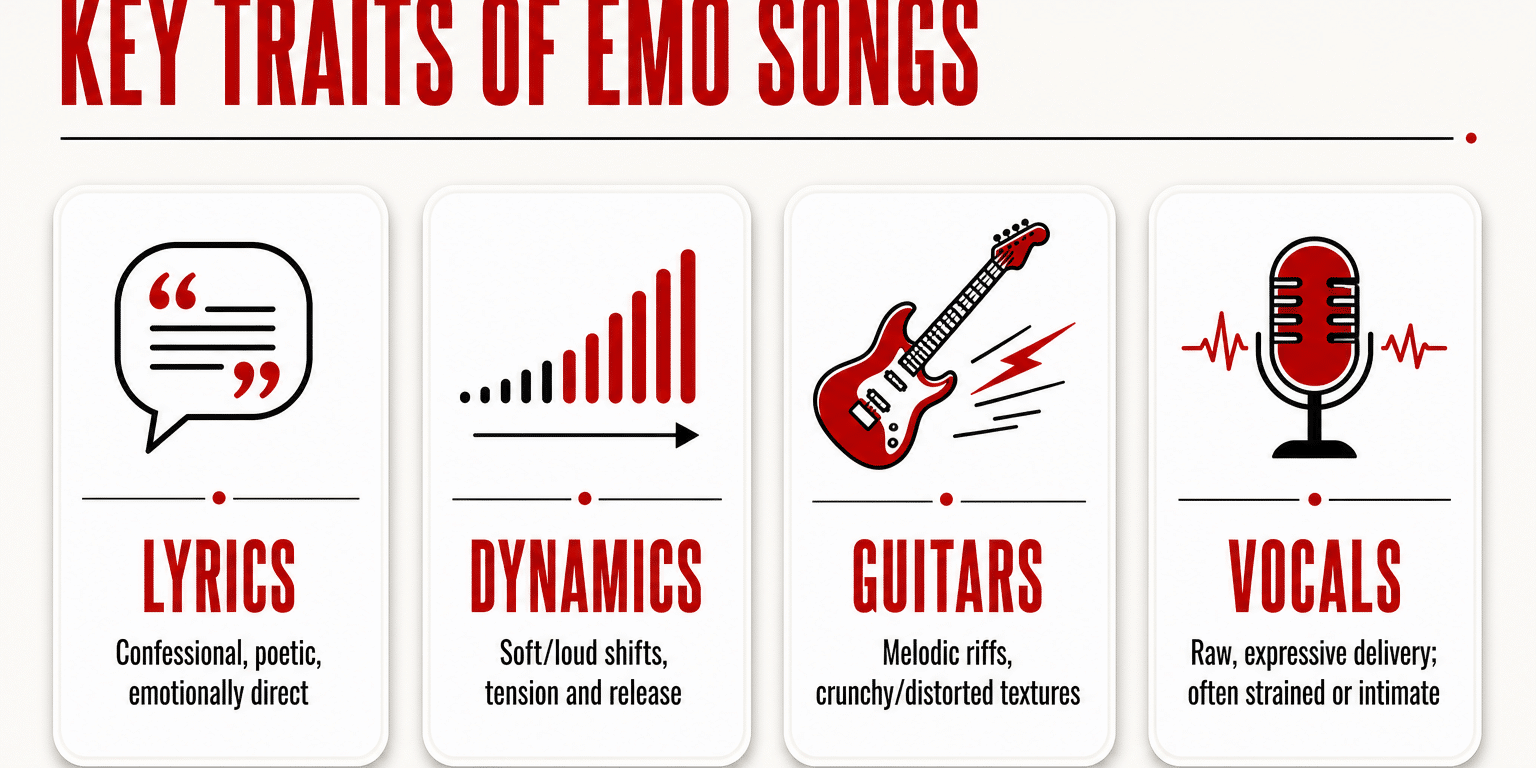
What is emo music? It is a broad and evolving style of rock that grew out of hardcore punk in the mid-1980s, distinguished by emotionally expressive songwriting, confessional lyrics, melodic instrumentation, dramatic shifts in volume and pace, and vocals delivered with unusual intensity and vulnerability.
The term originates from “emocore” — short for “emotional hardcore” — a label that emerged to describe a strain of punk that turned its focus inward, towards personal experience and feeling, rather than outward political confrontation. “Emo” is not simply a shortened form of the word “emotional,” even though emotional expression is central to the genre.
This guide covers the full history of emo music, from its punk foundations and pre-existing influences, through its underground growth in the 1990s and mainstream breakthrough in the 2000s, to where it stands today.
Emo music: a short definition
“Emo” derives from “emocore,” itself a shortening of “emotional hardcore.” The term emerged in the mid-to-late 1980s to describe a particular strain of punk music developing in Washington, D.C. As the sound spread and evolved, “emocore” gradually gave way to the simpler “emo,” and the label has been applied loosely — and sometimes contested — ever since.
Common characteristics found across emo music include:
- Personal, confessional lyrics — often exploring relationships, identity, loss and anxiety
- Melodic and sometimes intricate guitar parts — from delicate fingerpicking to urgent power chords
- Dynamic contrasts — restrained verses that build into explosive, cathartic choruses
- Expressive vocals — delivered with intensity, vulnerability or deliberate imperfection
- Punk, indie or post-hardcore foundations — providing the musical backbone
No single trait automatically makes a song emo. The genre label is broad and contested, and has meant different things at different points in its history.

The influences that shaped emo
Emo did not emerge from nowhere. Several earlier genres contributed something distinct to its DNA.
- Punk rock — provided the speed, rawness and DIY spirit that hardcore punk would amplify; the idea that music could be made and shared outside mainstream industry structures was foundational.
- Post-punk — bands began pulling back from pure aggression, introducing atmosphere, introspection and more complex arrangements, opening space for personal expression.
- Gothic rock — brought darkness, emotional depth and a willingness to explore themes of loneliness and isolation that would later resonate within emo culture.
- Alternative rock — demonstrated that guitar music could be melodic, emotionally direct and commercially viable without abandoning its underground roots.
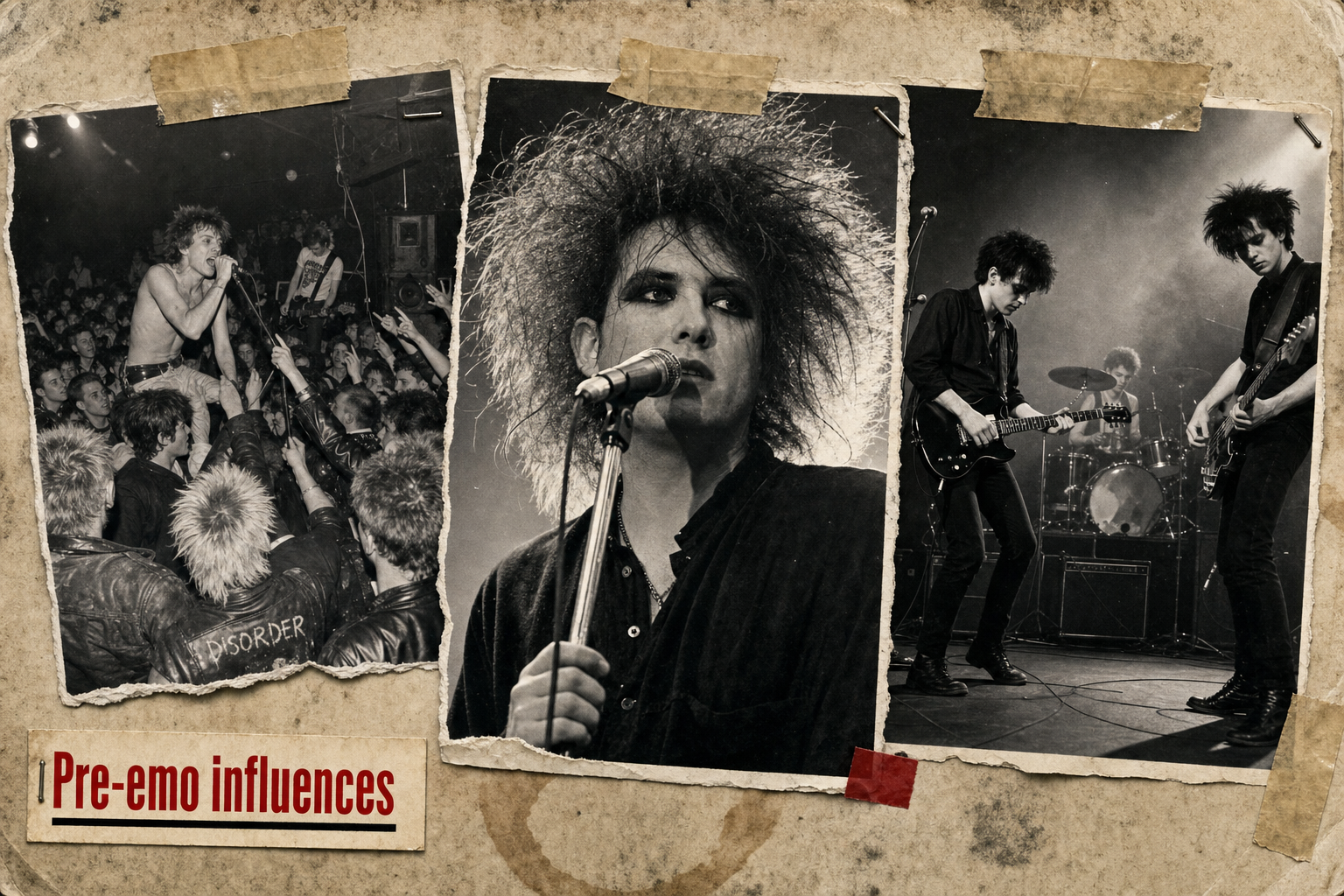
The Cure are a useful reference point. Robert Smith’s introspective lyrics, emotionally vulnerable songwriting and distinctive appearance influenced a generation of alternative musicians, and echoes of that influence can be heard throughout what emo became. However, The Cure are firmly classified as post-punk, gothic rock and alternative rock — not as emo originators. Their contribution is one of tone, emotional vocabulary and visual identity, not direct musical origin.
Where did emo music begin? The D.C. scene and Revolution Summer
Emo music is generally recognised as having emerged from Washington, D.C., in the mid-1980s, with the summer of 1985 — widely referred to as “Revolution Summer” — marking a pivotal moment in its early development.
By that point, D.C. had already established itself as a significant hub for hardcore punk. Revolution Summer represented a moment of self-reflection within that community. A number of musicians began questioning the aggression and rigidity that had come to define hardcore, and started making music that felt more personal, more searching and more openly vulnerable.
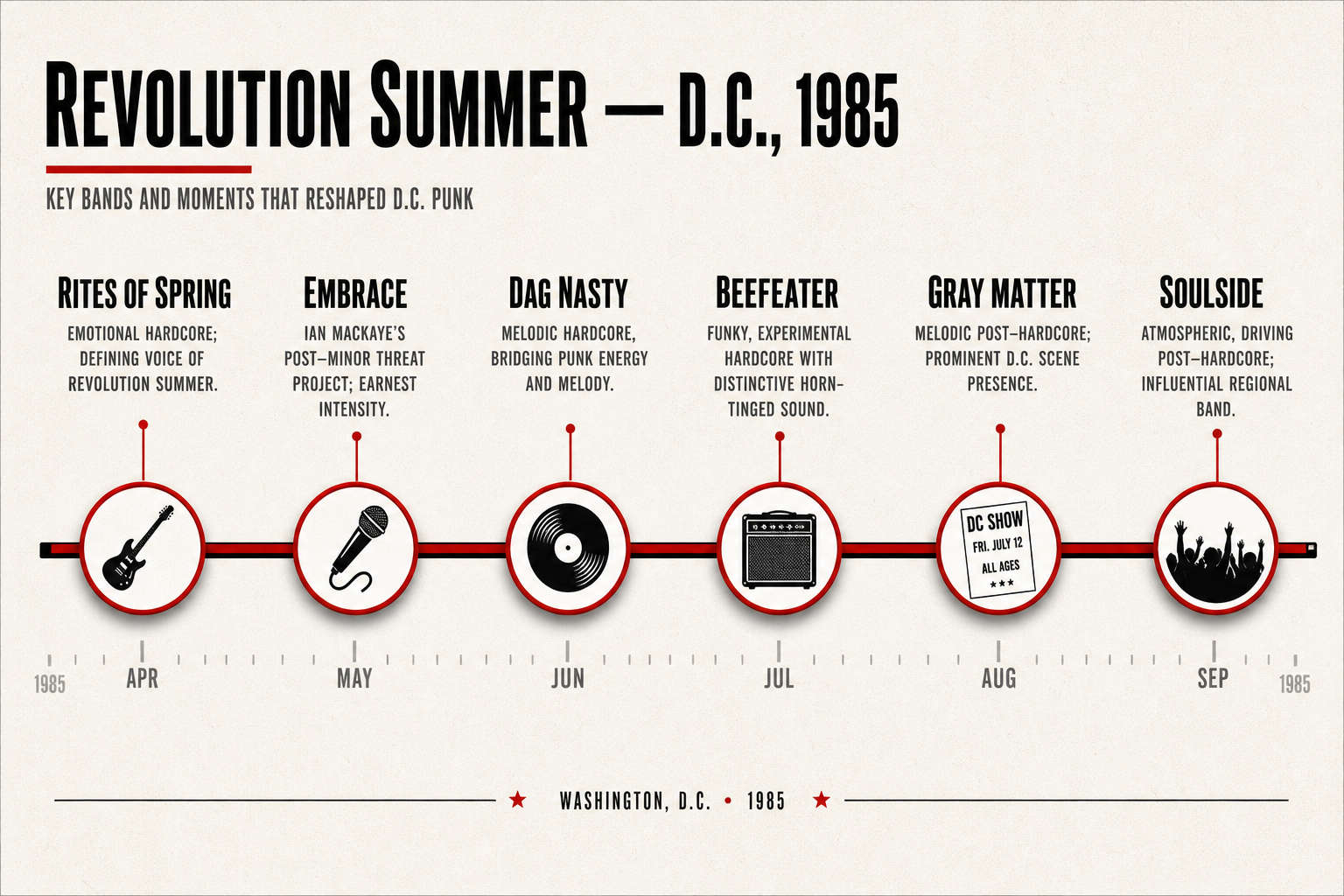
Two bands stand out as central to this shift. Rites of Spring retained the speed and rawness of hardcore but replaced its outward-facing anger with deeply introspective, confessional lyrics about grief, longing and personal struggle. Embrace, fronted by Ian MacKaye — already well known in D.C. punk circles — took a similar direction, prioritising emotional honesty over confrontation. Other bands including Dag Nasty and Gray Matter were also part of this broader transformation.
The term “emotional hardcore,” later shortened to “emocore” and eventually “emo,” was applied to this approach — though largely in retrospect. Most of the musicians involved did not use or particularly welcome the label at the time. Where mainstream hardcore had focused on political statements or collective frustration, these bands turned the lens inward, treating the stage as a space for genuine personal expression.
That shift, rooted in one city and one remarkable summer, set the foundations for everything that followed.
Emo in the 1990s: underground growth and Midwest emo
Through the 1990s, emo moved well beyond its D.C. origins and began absorbing the influence of indie rock and melodic guitar music, producing a more varied and musically ambitious body of work.
In the San Francisco Bay Area, Jawbreaker blended punk urgency with literary, emotionally raw lyrics that would prove enormously influential. In Seattle, Sunny Day Real Estate brought a more expansive, almost spiritual quality to the sound — their 1994 debut Diary remains one of the most significant records in emo’s history. Meanwhile, Chicago’s Cap’n Jazz and Champaign-Urbana’s Braid were helping to define what would become known as Midwest emo: a style characterised by intricate, twinkling guitar parts, unconventional time signatures, sudden shifts between hushed passages and full-band intensity, and vocals that prioritised feeling over technical polish.
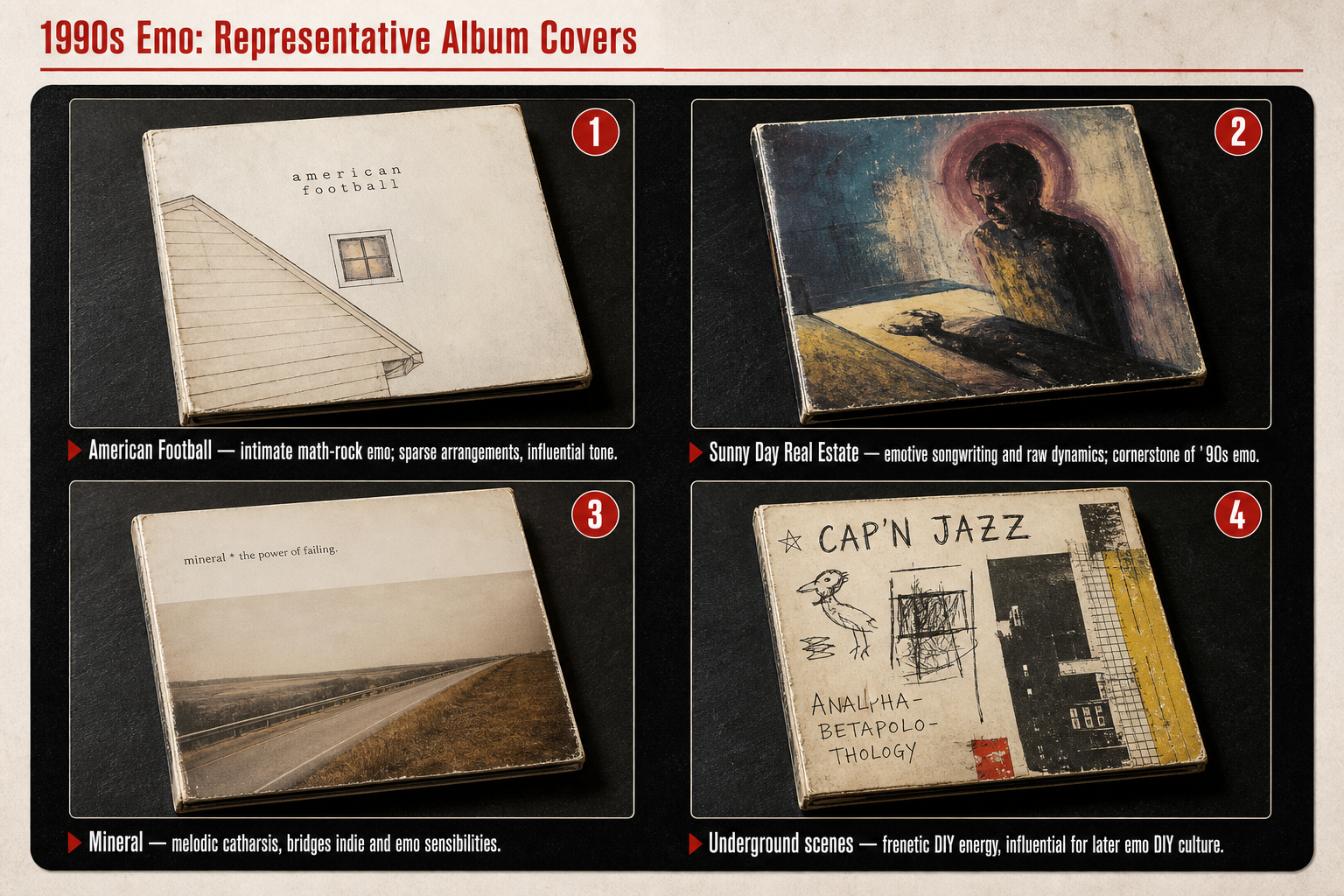
Other key artists of the period included Mineral, whose delicate yet devastating approach to dynamics became a template for many bands that followed, alongside Texas Is the Reason, The Promise Ring, The Get Up Kids and the early work of Jimmy Eat World, who were quietly developing the melodic sensibility that would eventually bring them widespread recognition. American Football, active briefly at the decade’s end, produced a self-titled album so quietly influential that its reputation has only grown in the years since.
The scene sustaining all of this was almost entirely underground. Records came out on small independent labels; shows took place in basements, community halls and small venues; music spread through physical copies, handmade zines and word of mouth. Discovery was slow, local and communal — which gave the scene a sense of shared ownership that remained central to emo’s identity for years.
Emo’s mainstream breakthrough in the 2000s
The early 2000s brought emo — or at least a version of it — to an audience the genre’s underground originators could scarcely have anticipated.
Jimmy Eat World’s Bleed American (2001) is often cited as a turning point, demonstrating that emotionally direct guitar music could connect with a genuinely wide listenership. Dashboard Confessional stripped things back to acoustic guitar and raw confession, finding an enormous fanbase in the process. Taking Back Sunday and Thursday brought post-hardcore energy and literary ambition; The Used added a more abrasive, theatrical quality. By the mid-2000s, Fall Out Boy, Paramore and My Chemical Romance were selling out arenas and appearing on music television worldwide.
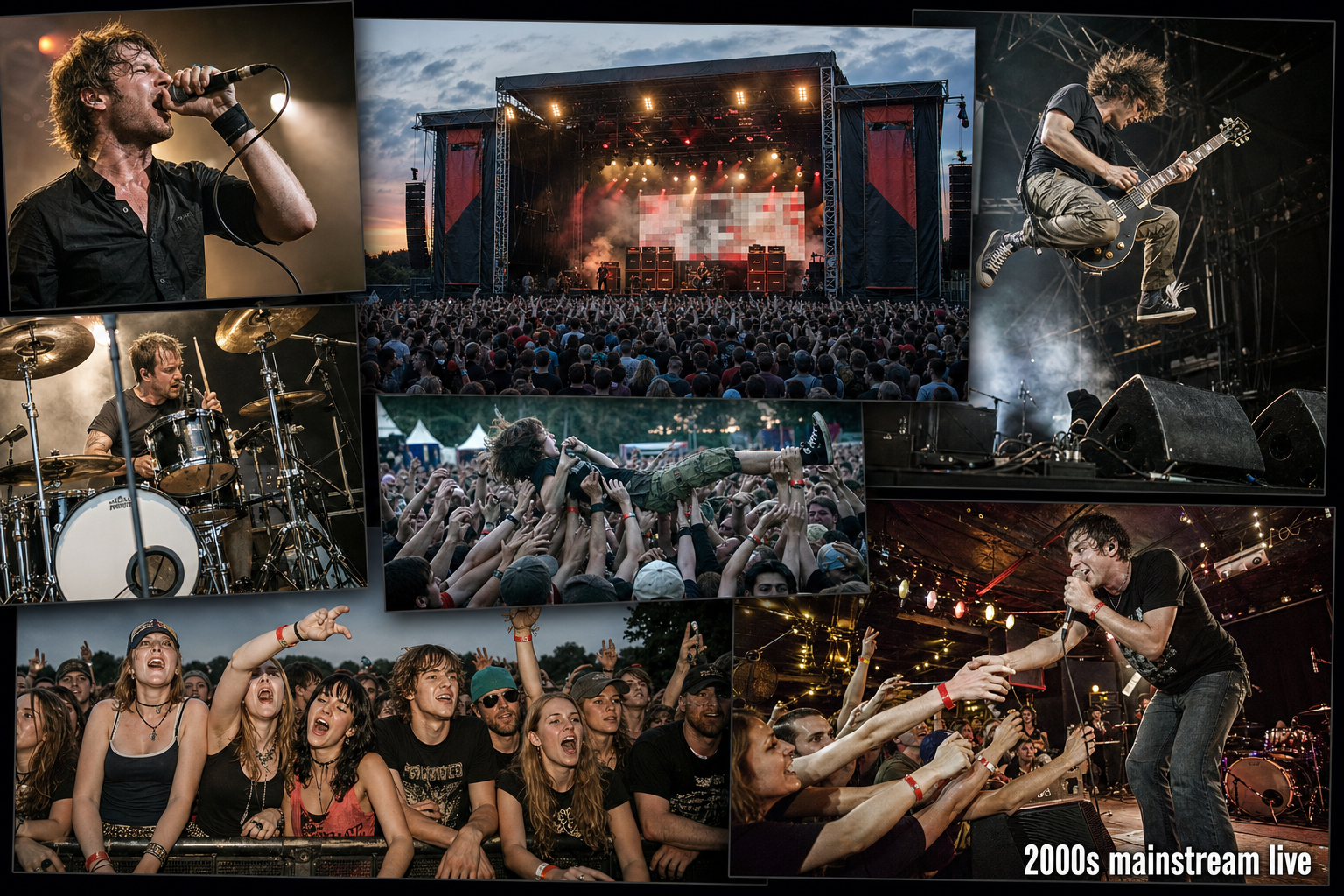
The broadening of the label was not without controversy. Mainstream media frequently used “emo” to describe music that many purists would have placed firmly in pop-punk or post-hardcore territory. Several of the biggest acts associated with the genre actively rejected the term. The differences between emo, pop-punk and post-hardcore are genuinely meaningful, even if those boundaries blurred considerably during this period.
Looking back, the music has proved remarkably durable. My Chemical Romance’s return to touring drew enormous crowds, and there is real demand for emo at events ranging from specialist club nights to weddings. The emotional honesty at the genre’s core clearly still resonates.
What makes a song emo?
There is no single feature that makes a song emo. The genre is identified by a combination of musical and lyrical characteristics. Most emo songs share several of the following:
- Confessional, personal lyrics — writing that addresses relationships, identity, anxiety, grief or loss in direct, first-person terms
- Expressive vocals — often raw, strained or imperfect in delivery, prioritising emotional honesty over technical precision
- Melodic and intricate guitar parts — ranging from delicate, twinkling fingerpicking to urgent chord progressions
- Dynamic contrasts — quiet, restrained verses that build into loud, cathartic choruses
- Punk, indie or post-hardcore foundations — emo’s structural and sonic roots in underground guitar music
- Cathartic intensity — a sense of release or emotional heightening, particularly in the song’s climactic moments

The quiet-to-loud dynamic is one of the most recognisable emo song structures. A track might open with clean, restrained guitar and understated vocals before erupting into full-band intensity at the chorus — a shape that makes the emotional payoff feel earned rather than imposed.
Emotional lyrics alone, however, do not make a song emo. A power ballad or a singer-songwriter track can be deeply emotional without belonging anywhere near the genre. The stylistic foundations matter — the punk lineage, the guitar-driven arrangements, the underground sensibility — as does the context in which the music was created and received.
Is emo the same as goth, pop-punk or alternative rock?
No — though the boundaries between these labels are fluid and often debated.
Emo vs goth: The two share some emotional territory, but they are distinct. Goth and post-punk acts like The Cure influenced emo’s introspective tone and visual sensibility, but The Cure are rooted in post-punk and gothic rock — an influence on emo, not an originator of it.
Emo vs pop-punk: Pop-punk prioritises catchy hooks, polished melodies and a lighter emotional register. Emo tends toward greater vulnerability and dynamic intensity. Many 2000s bands drew on both traditions simultaneously, which is why the two labels are so frequently conflated.
Emo vs alternative rock: Alternative rock is a broad umbrella that can encompass emo-influenced acts, but it is not synonymous with emo. Plenty of alternative rock has no meaningful connection to emo’s hardcore roots or confessional character.
Genre labels are always somewhat contested — these distinctions are useful guides, not fixed rules.
Emo music today: revival, legacy and new directions
Emo’s mainstream visibility declined after the mid-2000s, but the genre never disappeared. Underground scenes kept it alive, and in the 2010s a recognisable emo revival emerged, with newer bands drawing heavily on the Midwest emo template. Separately, emo rap — artists blending confessional lyrics with hip-hop production — brought the genre’s emotional sensibility to a completely different audience.
Legacy acts have also returned with considerable force. Reunion tours have drawn enormous crowds, confirming that the music retains a genuine hold on listeners who grew up with it and younger fans discovering it through streaming.
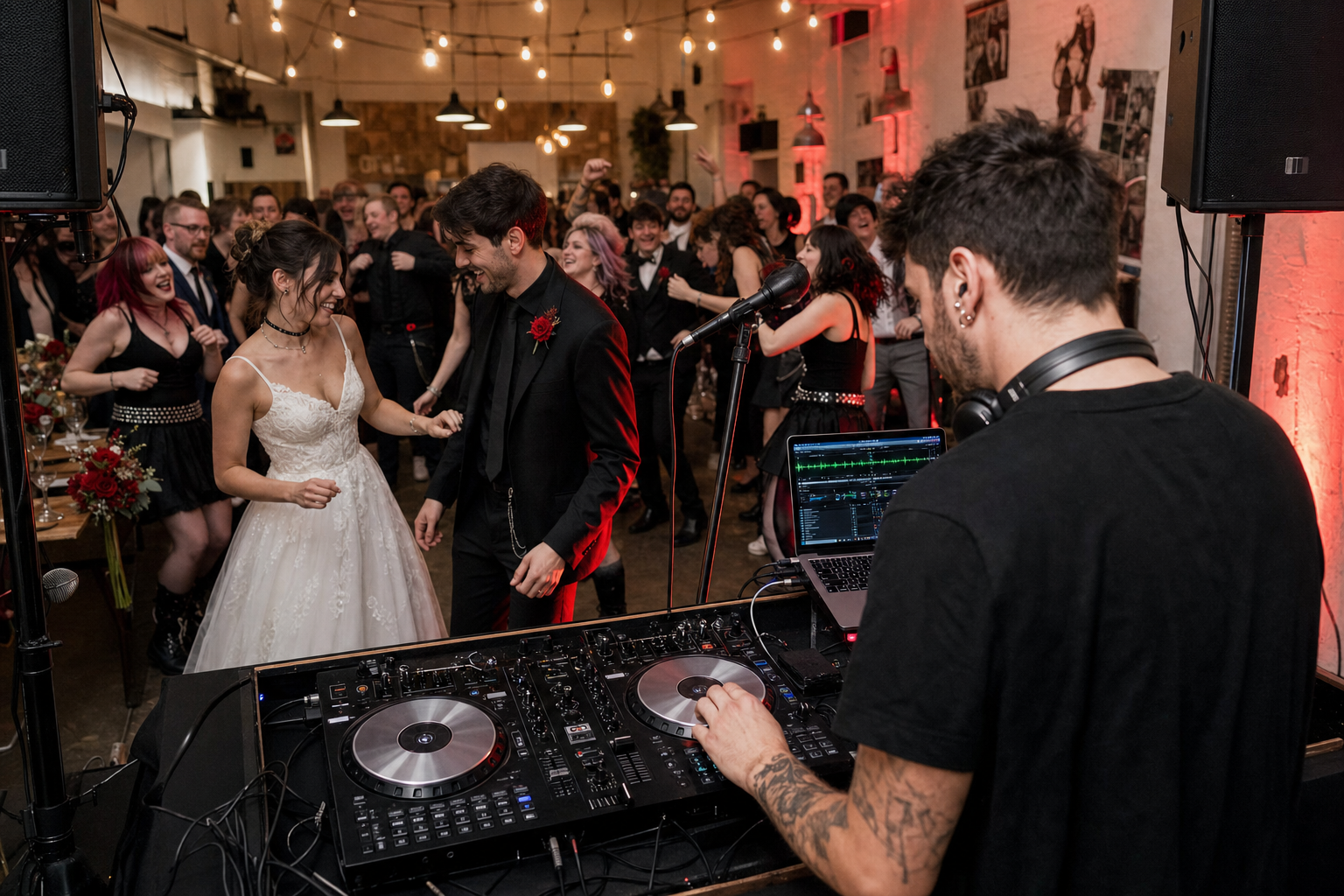
Requests for emo and pop-punk tracks appear regularly at weddings and events, and dedicated emo nights continue to sell out venues across the UK. If you’re looking for a DJ who understands the genre in depth, our emo DJ service covers everything from 1990s underground classics to 2000s anthems.
What is emo music? A genre that resists easy definition
At its core, emo music is an evolving branch of alternative music rooted in emotional hardcore — defined by vulnerable songwriting, expressive performance and an unusually close connection between artist and listener. It resists easy categorisation, and that is rather the point. Reducing it to a fashion or a mood misses what has kept it vital across four decades.
If you are planning an event and want a DJ who genuinely understands emo and its history, take a look at our emo DJ service — emo and alternative requests are among the most common we receive for weddings and private events. Feel free to contact ALT DJ to discuss your plans.